My AI Journey – Episode 2️⃣

Hands-On Time
After collecting everything I could about artificial intelligence (Episode 1) and exploring how it could apply to my field, I decided to move from theory to practice by completely rebuilding my website.
Goal: Put my new knowledge into action and test, in real-world conditions, what AI can truly bring to a content professional.
Rethinking my Content with AI
🤝 ChatGPT and Copilot became my tireless, multilingual, and surprisingly kind teammates.
Submitting your text to an AI means engaging in an endless dialogue — it always finds something to tweak! That's why you need to have the final say.
It's also a great exercise in precision and discipline.
AI helped me to:
- dig deeper into my ideas,
- refine my phrasing,
- explore new perspectives,
- all while staying true to my voice and editorial tone.
Result: A richer, clearer, and more authentic version of my site.
Redesigning Structure and Layout
🏗️ Docusaurus offered an excellent foundation — one I already knew well — and its high customizability made it the perfect playground.
I took the opportunity to deconstruct the default layout and rebuild the homepage to reflect my own style.
With ChatGPT's help, I revisited:
- The homepage layout,
- The display of blog articles
- React components,
- The CSS, optimized for better performance and accessibility
🟢 Advantages: A true co-creation space where you can think out loud, test, and iterate. AI becomes a digital whiteboard.
🔴 Limitations: Sometimes it hallucinates — wrong sources, outdated code, or logical dead ends. That's where your own knowledge and critical thinking kick in.
Bottom line: If you don't understand the code it suggests, don't copy it. AI isn't a GPS — it can just as easily send you down a country road... or straight into a wall.
Note: The layout, colors, font choices, and menu arrangement are the result of my own design, not that of an AI.
Staying in Control
🎮 Collaborating with AI also means knowing when to say no. I follow an iterative loop:
Human (H) → AI → Human adjustment → AI refinement → Final human validation
Since AI is always ready to write more, you have to know when to stop — and finish the job yourself.
Working effectively with AI requires the ability to:
- assess the relevance of its suggestions,
- rephrase independently,
- understand before approving,
- and be able to (re)do things without it.
Takeaway: AI amplifies your skills... if you already have them.
Custom-Made Visuals
🖼️ For visuals, I swapped stock photos for a generative-AI workshop, allowing me to create highly personalized images — even though I'm not a graphic designer.
I experimented with several tools, refined my prompts, adjusted styles, and learned how to build visual consistency across the site.
Result: A cohesive website aligned with my brand palette and creative universe.
And along the way... a little dinosaur mascot was born!
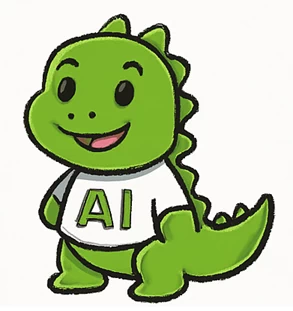
One of the mascot's avatars
Building an "AI-Ready" Web
😶🌫️ Beyond visuals and layout, I also rethought the invisible layer — metadata and the logical structure of the content.
Because today, the web doesn't only speak to humans — it speaks to AI models, too.
That led me to revisit, from both an SEO and GEO perspective:
- Metadata (tags, descriptions, alt text);
- And the logical content structure, to make it more accessible to AI systems.
My site is now a structured corpus — ready to become a documentation database (for a chatbot, for instance) or a foundation for Docs-as-Data.
Discovery: My former Hugo site actually handled metadata more extensively than Docusaurus — a valuable insight for optimizing indexing, SEO, and GEO.
A Truly Formative Experience
🙇♀️ This rebuild turned out to be much more than a technical project — it became a full-scale experiment.
It allowed me to:
- See firsthand how AI can amplify creativity;
- Strengthen my skills in design, content architecture, and technical writing;
- And validate my approach to "AI-Ready" documentation.
🟡 A deeply formative experience — for me and for my future clients.
As a specialist in documentation websites and Docusaurus, this project helped me put theory into practice, define what truly makes documentation AI-ready, and clarify how I want to collaborate with AI moving forward.
If you also use AI to collaborate on your documentation or websites, share how you do it in the comments on LinkedIn 😊